Showing posts with label nude. Show all posts

Monday, April 10, 2017

The Science Behind Drawing the Figure Intuitively

When an artist is trying to learn to draw a figure in proportion and get the arms and the legs all the right size, it takes a certain amount of deliberate study, since there are all kinds of things working against him (for example, psychologically, we give more importance to heads and hands, so we tend to make them bigger; foreshortening in a lot of poses gives artists false cues about how limbs relate to each other). So there's a phase where a developing artist might spend a lot of time deliberately measuring out everything in the drawing to get it just right. 

But all of that academic study may still not give the artist sufficient grasp of proportions so that they won't still be a stumbling block. 

So I encourage artists to work a lot from FAST poses, usually 30 second poses, and to do a lot of them. Why? Because in 30 seconds, there's simply NO TIME to think about what you see and transfer that into something you're drawing on the page. Drawing fast COMPELS you to develop an intuitive understanding of the figure and it's parts as a single whole thing. With practice, it compacts that "conscious competence" into the subconscious part of the brain where it becomes a reliable, intuitive function. Not guessing.


Abraham Maslow identified this in his "Four Phases of Learning." To paraphrase, the first phase is not knowing anything ("unconscious incompetence") The second phase is knowing you have to learn ("conscious incompetence"). The third phase is learning and understanding, but only at a conscious, academic level ("conscious competence"). The fourth stage, which is where you've internalized the understanding to the point of intuitive understanding is called "unconscious competence." 

Unconscious competence can be as exotic as an athlete pulling an impossible play to win a big game or as ordinary as pulling into a busy traffic lane while talking to the kids in the back seat. Unconscious competence is writing out words without thinking of how to spell them, etc.

Friday, December 16, 2016

Hiring and Working With a Nude Art Model


"Artist and Model," by Angelo Morbelli (1909)
There’s been plenty written for people interested in going into the field of art modeling, but much less written for artists interested in working with nude models. Working from a nude model is a traditional pillar of western art, but it can be an awkward situation for the inexperienced artist. And it can be a difficult experience for a model too. I have to say, I’ve heard some horror story experiences from models, and I’m hoping this article will serve to make the experience a more pleasant and fruitful one for everyone concerned.

If you’ve never worked with a nude model in any capacity before, it’s very worthwhile to spend some time at an established class or art school that utilizes nude models, if you can. Besides getting comfortable with the situation (and it’s perfectly normal to feel a bit awkward at first), you’ll be able to see how people with experience organize and run such a situation, and you may even be able ask for advice and get model referrals. If you are starting somewhere where you have no access to such a class, I hope this article will be of great help.

Professionalism
The media may portray the world of artists and models as something exotic and titillating, but the reality is that art modeling is a profession, like any other, and models should be treated in a mature, professional manner, and also be expected to behave in a professional manner. An art model’s skin is their working uniform, and it’s important to remember it as such. 

Unlike just about all other professions, though, an art model’s job is one in which they are inherently apt to feel more vulnerable, both emotionally and physically, and an artist/employer should keep that in mind. So be professional:

2.       1. Do not be overly familiar

2.       2. Do not make any physical contact

3.       3. Be respectful

4.       4. Be reasonable

5.       5. Pay properly, and respect the model’s legal rights

6.       6. Be aware of the time

7.       7. Don’t be a pushover

A simple rule of thumb is that the more comfortable the model is, the better a job they will do, and the better your art will turn out. 

1. Do Not be Overly Familiar
Maintain a professional demeanor. Treat the model as you would want your boss to treat you in an ideal work environment. You know that nightmare that people have of finding themselves at work naked? Imagine if it were happening to you, you’d want your boss to carry on as usual, maybe pretend not to notice, and not to make you feel any more vulnerable than you already do. Be that boss—professional and friendly.

If you happen to be an extrovert who oozes charisma and magnetism in your everyday life, it would be wise to tone it down in the studio, to avoid any risk of being misinterpreted. 

People who know me may know I’m the king of inappropriate comments, but when I’m working with models in a classroom, I turn off that part of my personality. Not only can it make the model uncomfortable, but it can make me seem less professional to everyone else in the class. 

Even if the model is a friend whom you know well, when they’re holding a pose, they’re working. You probably wouldn’t want your friends bugging you at work, either. 

If you’re working with a model privately, overly informal behavior can make them feel uncomfortable. And if you’re running a class, you may also influence the students in the class to behave in an uncomfortable or overly familiar way towards the model or each other. 

2. Do Not Make Any Physical Contact
This ought to be pretty obvious. If you work in a factory, you do not want the guy you’re working for touching you, even if you’re in overalls and a welder’s mask. It’s annoying and it can be considered harassment. So don’t touch the model. If you want them to pose in a particular way, use words to let them know. Gender doesn’t matter in this case—a female artist has no more right to touch a model of any gender than a male artist does. 

If a model is doing a long pose (day or weeks long) the pose is usually broken into 20-minute segments. During the breaks, it’s not uncommon to outline the placement of the models feet on the floor with tape so they can step back into the exact positions—but still, tape around the model, or better yet, hand them the tape and let them do it themselves. Don’t touch them.

3. Be Respectful
Be the kind of boss you would want to have. Don’t be pushy, critical or unreasonable. Remember that you have hired the model to pose for you, and most models want to do a good job for you, so making their job harder or more stressful will only make it harder for you. If you want specific poses, clearly explain what you’d like, and most models will try to oblige to the best of their ability. But if they feel they are unable to hold certain poses, give them the opportunity to tell you so. 

If you have a problem with something about the model, bring it up with them privately. Do not embarrass the model in front of the other people. Every model I know seems to have horror stories about working for artists or teachers who were just horrible people, who bullied or embarrassed them in front of the entire class, and I’ve seen a few teachers seem to get a kind of erotic thrill out of ordering the models around and making them unhappy. One model I know was loudly criticized by a teacher about the color of her fingernail polish. Another model I know was asked to bend backwards—and hold it for four hours. 

If you treat your models badly, they have no reason to come back and work with you a second time. But much worse—you can get a bad reputation, and since most models network with each other, a bad reputation is one that will haunt you and make it much harder for you to hire other models in the future. Conversely, if you have a reputation as someone models can trust and feel comfortable around, they are much more likely to want to work with you, and refer other models. And if you’re part of an institution, the model may have recourse to complain to the management about you. 

4. Be Reasonable
“Kick your leg up in the air… and hold it there for 20 minutes!”
If you want a specific pose, by all means give your models directions, but remember the models are only human. If a model feels comfortable with you, they may try to go the extra mile, sometimes even when they should know better. Don’t ask for things the model can’t comfortably do.

Also, be aware of comfort issues like room temperature. Not only is the model in an emotionally vulnerable state, they are also physically more vulnerable to the conditions around them. You may be comfortable while the model may be freezing (and remember that very thin models and older models are much more sensitive to cold). Be sure there is sufficient heat in cold weather. If it’s really cold, offer them the option of posing in clothes or semi-draped. Always give the model the option of breaking the pose early if it’s too much for them or they get a cramp. I’ve known models who will pose through muscle cramps and fevers, and I was in a class where a model passed out in the middle of a pose. There’s no need for that. 

The kind of poses a model can hold for one minute may not be possible to hold for 5-minutes, and a 5-minute pose may not be possible to hold for 15-minutes. An experienced model knows what they can and cannot do, and if you give them the opportunity they can tell you so, which will avoid disappointment for everybody. 

If you’re working with an inexperienced model, it will be a learning experience for both of you. If you have experience, your directions can be quite useful for the model. If you’re new at it, too, the most important thing is to keep your eye on the clock so that the poses and the breaks are accurately timed, and communicated clearly. 

Specifically regarding long poses, even if you have the world’s greatest art model, I can guarantee you will observe some or all of the following phenomena: Muscle relaxation—as the model settles into a long pose their muscles will slowly relax. It’s more obvious with well-defined models, but it happens to everyone. Blinking and eye-movement, fingers or toes moving, or torso turning gently—models are only human, and holding still for long periods of time is unnatural to the human body. Some people’s neurology will respond to the unnaturalness with little motions. these aren’t really within the control of most models, and they shouldn’t significantly affect your finished artwork, even if they disturb your concentration a little bit. Breathing—Do I really have to mention this? Apparently so. Some people complain about the model’s breathing! As an artist, it’s better to learn to deal with these eventualities than let them affect your concentration, and if you’re running a class pass that learning along to the other artists there. 

Also be aware that good models may have a lot of other modeling jobs in the course of a single day, and you shouldn’t be so demanding that they are too worn out, injured or sick to complete their other obligations that day. Poses that can cause your models to cramp up or become sore, or conditions that can leave them with chills or a cough should be avoided. Imagine if you book a model and they have to cancel in the last minute because the artist they posed for immediately before you left them so sore or sick they can’t do anymore. Don’t be that guy.

5. Pay Properly, Respect the Model’s Legal Rights
Set a price per hour or per session and stick to it. Be sure to make the rate clear to the model beforehand, and that they agree to it. 

Also be aware that the rate for photography modeling is higher than the rate for drawing and painting. There are different laws involved in photography modeling and the models have different rights that have to be respected. This means NO taking “reference photos” for paintings or sculpture unless you’ve discussed and negotiated it with the model before you start

Generally, when you do a drawing or painting of a person, you have rights to that piece of art as your own creation. However, when you take photographs, the model retains rights to their own image, unless they legally release those rights to you by way of a document called a model release, which you should always use when photographing a model. You should keep these release forms on file, because you’ll have to produce them if you want to have your photos sold or published, or shown in galleries.

What rate should you pay a model? It varies considerably, based on what part of the world you’re in, and what you’re asking the model to do. The best way to find the going rate is to ask local schools or artists, but remember there is always some variation, and some studios pay more than others, like any other job. Also, each model has a rate they’re willing to work for. Some may ask for more than whatever the “standard” rate is. It’s their prerogative. 

6. Be Aware of the Time
As artists, we always seem to need just one more minute to finish a drawing. But be aware that more experienced models know exactly how long they can hold a particular pose, and running overtime can result in aches and cramps and make later poses more difficult for them. 

7. Don’t Be a Pushover
So far I’ve touched on your responsibilities towards the model, but at the same time, the model has equal responsibilities to you. You have a right as an employer to expect the same kind of professionalism that you show the model. Most of the time, everything will move smoothly, but there are a few common difficulties that you might encounter.

1. Lateness
Personally, I don’t mind if someone’s a few minutes late. Travel can be unpredictable, and things happen. But if you are teaching a class scheduled for a specific time, you also have a responsibility to your attendees to start on time, and more than a few minutes of lateness can make the paying customers unhappy. 

2. Last minute cancellations
Stuff happens, maybe a model gets sick, and they have to cancel in the last minute. But this is usually a pretty rare occurrence. If a model has to cancel, they ought to give you enough advance warning that you have sufficient time to book a replacement. It’s not reasonable for a model to cancel an hour before a class, since it doesn’t give you any time to book a replacement.

3. Unprofessionalism
Inappropriate behavior, poor hygiene, disrespect, compromised mental state (ie: being high or drunk) and even flirting, are much rarer situations, but they occasionally do arise. These can require a little more delicacy to deal with. For example, I’ve had a model who behaved inappropriately as a result of receiving bad news immediately before coming to work, in which case a few moments to compose herself before we started did the trick. 

Poor hygiene is pretty unusual for art models but it sometimes happens. Usually, they’re already more self-conscious about it than you are. The very few times it’s happened, I haven’t said anything, and it hasn’t been repeated. 

Compromised mental states may include being drunk or high, but sometimes it can also be a result of illness or even prescribed medication. Don’t judge too quickly, but do get to the bottom of it and discern whether it is a problem you can work around and whether it may be a problem in the future. 

Very occasionally, you might even have a model act disrespectfully. Don’t assume any of the above problems are meant disrespectfully by themselves, but if a model is clearly demonstrating they are unhappy with the job, or you or the class, that they are testing you, or they just don’t want to be there, it can create an uncomfortable work environment.

One summer I had a lovely young blond model that all the members of my art group really enjoyed drawing. At first she was excellent, offering us a variety of interesting poses, and really inspiring the group. But she quickly caught onto how popular she was with my attendees, and she started testing the boundaries by showing up later and later each time I hired her, and becoming lazier and lazier in her poses, to the point I had to give her direction for every single pose, or she’d just lay on the floor in the same position all day. She really pushed my boundaries too far. I stopped hiring her.

Flirting. Nudity is a two-edged sword. Just as a person working nude is in an inherently more vulnerable state, their nudity can also be more intimidating if they choose to act flirtatiously. It doesn’t matter if they are flirting with the students, other models or you, and it doesn’t matter whether the model is male or female. It may be perfectly innocent, but the recipient may not feel that way, and in any case, it will make all the other people in a class feel a little awkward. Should it happen with your model, be aware that they might not be doing it consciously. But intentional or not, make clear that the behavior they’re showing may compromise the work environment. 

In all the above cases, DON’T LOSE YOUR COOL. Don’t chastise the model in front of the class, but call them aside, and discretely discuss it with them in whatever way is appropriate, and strive for a win-win conclusion. Personally,  I feel it’s better to smooth over ruffled feathers and find a solution to make everyone happy, but also, when you lose your cool, you also lose your authority, because it looks like you’ve lost your control of the situation. That’s never desirable, especially if you’re running a class. If the model continues to behave unacceptably, don’t fight with them, just don’t hire them again. 

In conclusion, I hope this has been a useful and practical guide. In addition to running figure drawing groups for over 20 years, both in schools and independently, teaching art, and producing art events and draw-a-thons, I also have a few decades of experience in managing production departments and projects for major advertising agencies. My experience is, 99% of the time, when you treat your people with confidence and communication, and work with them rather than over them, they will give you the best they have to offer.
© Jeff Sauber
Thanks to Gerry McGann for catching the typos!

Thursday, September 29, 2016

Is this the LAST Draw-mania! ?

Draw-mania! 55, on Tuesday, October 18th., will be the FINAL DRAW-MANIA!

It's been a great run! 5 years (longer than most jobs I've had!), and in that time, we've had artists come from all over the world to draw-with us, we've probably entertained you with 200 performers, 50 figure models and 2 renown DJs! Not bad, huh? But all things must come to an end. So if you've been putting off experiencing our unique artists' experience, please come and celebrate with us on October 18th!
For more details: https://www.meetup.com/FigureSketching-NYC/events/234498763/

So come and join us!
As always:
Over 21; Bring ID--they won't let you in without it
Bring you own art supplies


Tuesday, Oct. 18th, 8pm-midnight $20 at the door

Otto's Shrunken Head
538 East 14th st.
Between Ave A & B
New York City


Friday, February 15, 2013

Draw-mania! Goes INTERSTATE!

Hi folks!
Sorry I haven't posted anything new in a while. The Summer Sketch group has been going strong, still meeting a couple of Sundays every month (all year long, not just the summer), and attendance has been terrific--enough people to get a fun sense of community but not so many that it becomes awkward or overcrowded.

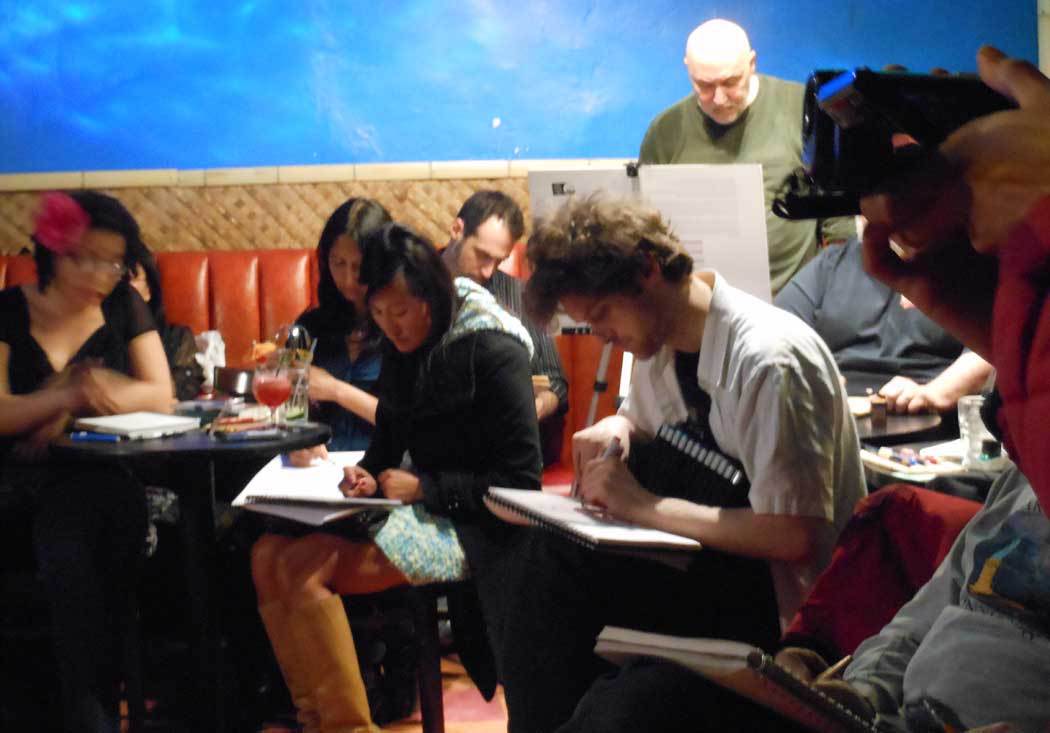
Draw-mania!, our monthly draw-a-thon and variety show, has really taken off! We're approaching our 15th event, and we're going strong into the coming year. If you've never been to one, just imagine a space filled with over 30 artists of all skill levels, from absolute beginners to seasoned pros, sketching, chatting, and, should they so desire, drinking, as they draw from 6 of the top art models for four hours! There's a break for the models every 20 minutes, and that's when a comedian, storyteller or musician takes the stage for a 10 minute performance. It' a blast!
We've been going strong every last Monday of the month in the East Village, at the possibly legendary and always amazing Otto's Shrunken Head (538 East 14th st.). Well, Starting in March, we're adding a second monthly Draw-mania!, just across the Hudson river, in Hoboken, NJ! If you're not familiar with Hoboken, you should be! It's incredibly close to Manhattan (The Hoboken PATH Train station is about 8 minutes from Manhattan's 14th st. & 6th Ave PATH station), and in the 80s it was where all the artists went after Soho priced them out. Nowadays, it's a cool, cozy neighborhood that features a lot of unpretentious bars and restaurants. We'll be at Teak on the Hudson (16-18 Hudon Place), a rather upscale place with a fun, exotic vibe, great cocktails and food, and an amazing riverfront view! Our first event will be March 6th, 8pm to midnight, and I'm putting together a great lineup of models and performers.

Hope you can make it, it's gonna be a blast!

for more info:
www.draw-mania.com

If you're on Facebook:
https://www.facebook.com/DrawMania

And if you're on Meetup.com:
http://www.meetup.com/FigureSketching-NYC/
http://www.meetup.com/Figure-Drawing-HOBOKEN-Draw-Mania/

Wednesday, May 30, 2012

Looking for modeling work? Here's some guidelines...

Summertime is especially hard for a lot of models. A lot of the schools are out, and the artists who might be hiring privately are enjoying some rare time out of the studio or shopping their canvases around trying to get a sale. I certainly understand that it's frustrating for a model, and I certainly respect anyone's attempt to drum up business in our current crazy economy.

I run a few classes, but not that many, and I have a limited number of availabilities for models, nevertheless, being out there, models frequently contact me looking for work. But one thing that really strikes me is how badly a lot of models present themselves. I'm currently in the "self-improvement" field and I coach people is all sorts of business and goal related skills, and before that I worked in advertising for many years, where I often freelanced and had to promote myself, and just as frequently was in charge of projects where I did the hiring. So I've been on both sides of that coin.

Here are a few pointers in presenting yourself--your best self.

First Impressions are HUGE
Remember that the first impression you make will color everything else people will find out about you, so make a solid, professional first impression.

Present Yourself Professionally
The first contact you have with a prospective employer should give them the impression that you know your business and that you have a clear grasp of what the job entails.

Be Honest
You don't have to lie about your experience if you don't have a lot. But don't sell yourself short, either.

Pricing
Do some research and find out what is reasonable to charge your clients. The fees a model gets vary widely in different parts of the country. You don't want to cheat yourself out of some bucks, but you also don't want to price yourself out of work, either. Call the kind of places you want to work and ask questions, talk to other models, and find out what's reasonable. Remember, also, that rates for drawing classes differ widely from photography. Some people will want to haggle with you for a lower rate, others can't afford to pay more than a certain rate, so know what you're willing to work for, and whether you're flexible on that point. In any case, don't start looking for gigs without an idea of what you'll be getting, and don't be shy about asking.

PUTTING IT ALL TOGETHER

DON'T
Send an email asking "Hey--need a model?" and wait for a response before sending more. You won't get a response. I get a lot of emails like this, and I no longer even respond. It tells me whoever sent it isn't really putting much effort into their modeling, and no particular pride in it. They may not have ever modeled before. There are plenty of models who take their job seriously and want the people they contact to know it. 

And don't forget to check your spelling. I'm a terrible speller, but I've discovered no matter how smart I am (or think I am), if I spell words wrong, I don't get taken seriously. So I found a free plug-in for my browser that checks my spelling.

Don't agree to take a job until you find out what they're paying!! I try to be very fair and upfront, but I'm surprised how many models will agree to take a job before I've even told them the particulars.

Don't stalk a potential employer! If they have a class that's open to the public, it's probably OK to drop in and say hello, and maybe (ideally) drop off a printed copy of your description and picture (see below). You should definitely follow up with everyone you've contacted for work maybe every 2-3 weeks, but for heaven's sake don't call or email every week, call several times a day, or any of those things you wouldn't want your ex to do.

DO
Send a brief business-like letter, just one or two paragraphs, that describes yourself, the kind of modeling work you're looking for, your experience (If you've modeled for well known schools, artists or been in well known projects, let people know! Don't be shy, show off!),  areas where you're willing to work (how far you're willing to travel, for example) and anything else you think might be pertinent. Be sure to include contact information.

And definitely include a picture or a link to a web portfolio, if you have one. Your work involves inspiring artists with your appearance, so share it! Don't necessarily send  nudie pic, in fact, even if you're looking for nude work, I think it's better not to until you know more about who you're contacting. Do send a nice headshot. It doesn't have to be professionally taken, just nice and clear. It will help people remember you, give them an idea of your look and body type, and give you a huge advantage. If you've been modeling a while, you might want to put up a web gallery of your favorite pix. It can be very persuasive.

If you're comfortable with the price you want to charge, you can consider putting it into your email, though some people think it's better to discuss your rate only when you talk to the person on the phone or in email exchange. Personally, I always like to save the talk of pay until I talk on the phone with a person when doing any kind of job discussion. You can get a better feel for the kind of a person you're dealing with and what kind of a job it is.

I hope this info is both helpful and lucrative. There are a few older posts on this topic and other model-related information. feel free to read it, share it and comment on it. I'd love to hear what you have to say.

Wednesday, April 11, 2012

Draw-mania! Testimonials

Sure, I have great things to say about Draw-mania!, our monthly art-a-thon extravaganza, but what do the people who come to Draw-mania! think about it? Watch!
http://www.draw-mania.com

Thursday, March 8, 2012

Come To Our Events! NOW!

I guess I've been remiss in posting to the blog for a while. But as many of you know, We've been going strong out in the real world! Summer Sketch session are still meeting roughly every two weeks. You can sign up for the next one(s) here: http://www.meetup.com/FigureSketching-NYC/
And in concert with my friend Pedro Hernandez, and an incredible crew of models, we've been presenting the Draw-mania! draw-a-thon, which is now a monthly event at Otto's Shrunken Head on 14th street in Manhattan, the last Monday evening of each month. We feature half a dozen of your favorite art models (some of the top models in the city!), a terrific DJ, and a ever-changing assortment of performers to entertain during the breaks. For the latest on that, go to th website http://www.draw-mania.com and like the Draw-mania! page on Facebook http://www.facebook.com/drawmania


Tuesday, September 20, 2011

Draw-Mania! THREE Thursday, Sept 22, 8pm


First off, a big apology for not posting about this to the blog earlier. I've been trying all kinds of different avenues to get the word out about this, and it looks like I overlooked the one right under my nose!

Well, here's the skinny: This Thursday, Sept 22 at the Bento Burger Lounge (101 East 2nd st., upstairs). The Bento Burger is part of the Lucky Cheng's Arts Complex, so to speak.

As with all the others we're offering the talents of some of New York's best and most popular art models, male and female, in an assortment of poses. We also have DJ Shred, a well-known DJ specializing in 80s and Depeche Mode in particular (but not exclusively), some terrific musicians and comedians, raffle prizes and drink specials!

It runs 8pm till midnight and you get it all for a scant $15 smackers.

And I promise to post more frequently about it!

for all the information go to the website: http://www.draw-mania.com

Thursday, March 10, 2011

Posemaniac lets you develop rapid sketching on computer or smartphone


This is soooo cool!
http://www.posemaniacs.com/thirtysecond

Anyone who's taken a drawing class with me knows that I love 30 second poses. There's even an article on this blog about why 30 second poses are so good for you when they seem so frustrating at first. They have a lot of benefits, but I'll recap the most important in a nutshell: Quick sketches internalize the form into your mind faster. Working that quickly, you can't get hung up on the details, just the "gesture" (or motion of the figure) and the proportions. And after you do these for a while, the "feel" for the figure becomes ingrained and instinctive.

And besides, once you start to get 'em, quick sketching is REALLY fun!

So what do you do if you can't make it to my sketch group? Go to http://www.posemaniacs.com/thirtysecond

There, on your screen, you'll have 30 second poses generated for you to draw. you can actually set it for different intervals, and in fairness, the figures are computer-generated and can be a little hard to "get" for the first 5 minutes or so. It also offers you odd angles that you'd rarely get to see a live model from, like form underfoot, and even a very useful "negative space option."

You can select specific poses from the pose files, and many can be rotated too, and you can also bring up a grid to make it easy to reproduce the proportions accurately.

Stick with this program and you'll find your mastery of the figure increasing quickly and dramatically.

The site also offers other links for specific anatomical part & details, but you may have to engage your browser's Japanese translation in order to get the most out of it. (the Google toolbar offer a really good one, but there are others, too).

Special thanks to Jim Fleming for letting me know about this!

Tuesday, February 15, 2011

Audrey Munson, America's biggest art star


She was the American Venus, Miss Manhattan. She was the inspiration to the tops artists, sculptors and architechs of her day, then went on to becoming one of the worlds first movie stars, and the first to do a tasteful nude scene--in 1915!!

As if that wasn't enough, she rubbed elbows with the elite, found herself at the center of a love & murder scandal, and lived to 104.

After her "discovery" on a street corner by a prominent photographer of her day, she went on to inspire sculptures that can be found literally all over New York City, from the Strauss Memorial at 106 street & West End Ave., to the Brooklyn Bridge, on the dimes & half dollars of her day, and on fountains and buildings all across the country.

Check out her biography http://en.wikipedia.org/wiki/Audrey_Munson, and this terrific little video about how she graces our fair city:

And this excellent little blog:
THE BLUE LANTERN: Audrey Munson: Her Brilliant Career

UPDATE! A new book has recently been written about our hero, Audrey, called "The Curse of Beauty" by James Bone from Regan Arts. Here's a link to a great hyperallergic article about Audrey and the book, with some astounding pix!
http://hyperallergic.com/292956/the-life-of-one-of-the-20th-centurys-most-influential-nude-models/

Monday, March 2, 2009

What good is a 30 second pose?!

I occasionally help run sketch classes in a couple of schools around the city. I often end up with the dubious moniker of "30-second man." Despite what some of my ex-intimates may say, I earned that name because, when I run a class, I like to start out with ten 30-second poses. Now, most sketch classes will start out with one minute poses, so why cut that in half? As it stands, a one-minute pose is so fast...

When I was first introduced to 30-second poses, it took me a while to get to like them. I'd already been drawing nudes for a long time, years in fact, and never did anything shorter than a one-minute pose. It was in Nathan Cabot Hale's class at the Art Student's League in the 80s that I was first exposed to the 30-second pose. Hale, a relative of the famous ASL instructor Robert Beverly Hale, was a sculptor and an anatomist with a fierce demeanor and a good sense of humor. He felt 30 second poses were good for you, and since he knew his business, I thought I should give it a try. Besides, some of the other students would just sit out the short poses without even trying, and I didn't want to give up like that. I rarely refuse a challenge. I rapidly learned to love the 30-second because of how quickly my drawing improved. Why? Here's why:

--You just barely have enough time to capture the gesture, the movement & feeling of the pose. You can't get hung up on any of the details. This is more important than it seems at first. One of the problems a lot of people have is that their drawings seem stiff and woody. The drawing doesn't have the spark of life to it. It may even seem overworked. In 30 seconds, if you get much, it will mostly be that spark.

--You just have enough time to draw the whole figure. Which means you just have enough time to see the whole figure. Getting the parts of the figure all in proportion to each other can be a very difficult thing, and the trouble is that as we draw, our attention gets hung up in the details, as whatever part of the body we spend more time on can come out bigger on paper (usually the head or hands). You can even see this happen on drawings by some of the great artists, even Prud'hon.

--You begin to perceive the figure as a whole in your mind, and this lets you work more quickly.

--You begin to remember more with each glance.
--An inspired model can strike short poses that they could never hold for longer.

--After doing a few 30-second poses, the one minute pose seems like its five times as long, and you'll get so much more out of it.

Sounds like they're worth giving a try, now, right? After all, 10 poses in five minutes..it's a little investment with a big return!

Monday, February 23, 2009

Tips for art models

For the first substantive post to this blog, I expected I'd post information about some upcoming classes, or pontificate about the changing face of the drawing scene, or a nerdly article on pen points.

Saturday night, I got home from one of Michael Alan's looney Draw-a-thons in the wee hours, and chanced to check my email. There was one from a girl who was asking me if I could give her some tips on breaking into nude (art!) modelling. I spilled out my thoughts, and decided this was a sign... And so my fist post ! Mind you, I've never modeled, but I know what inspires me, and I know what I look for when I hire a model. I'd really love input from some models who know the other side of the pencil.


Hi,

Best way to start, attend a couple of different classes, see how the models do and see how the artists respond. first off, you'll get an idea of what is expected of the models, and you'll also get to see what makes a good model, and what doesn't (as with any other profession, some people do their job better than others).

For artist's models, looks aren't necessarily important. Being able to come up with interesting poses, and being able to hold them, are the top skills.

Holding the pose is really important, since it gets very frustrating when you're 20 minutes into a drawing, and the model is slowly twisting into a different position. Not moving means not moving anything, including your eyes. Of course, your body follows where your eyes go, so if you fix your eyes to one point, you should be ok. Bored, maybe, but OK.

For sketch classes like mine, I don't do a pose longer than 20 minutes, but if you're posing for a painting class or a sculpture class, it can go on for a week or more (boring, I guess, but regular work!). In that case, the pose is typically broken up into 20-25 minute sessions, with a 5 minute break. At the end of the first 20 minutes, the monitor will usually put tape on the places where your feet are to help you find your place again. Being able to hold a pose is a highly regarded skill!

Being able to offer interesting poses will make you a desirable model! The best models have a good sense of motion in their poses, and that makes for exciting drawings. This is where dancers & yoga practitioners have an advantage. If you're familiar with ballet, think Jose Limon over Martha Graham. If that doesn't mean anything to you, one good way to create a sense of motion is to be asymmetrical, or slightly off balance. Or use the poses to act out a story, or express your inner demons.

Having fun will make posing, or any job, more easier.

Just remember that you'll be going for hours, so pace yourself, too.

As far as working conditions, most of the people you'll be working with will be pretty cool. Sketch classes traditionally have been quiet, meditative places, but there are a new breed, like Michael Alan's Sketch-a-thon, and Dr. Sketchy's in Brooklyn. These are more like performance art and/or burlesque, and usually have costumes, themes and music.

Hope that's good for a start!

If you go to the "files" section of the Meetup group, you'll find a PDF I created called "Classes around town." It lists all the classes I know of in the area. That ought to be a good start. Also try colleges with art departments (Hunter, CCNY, NYU, etc).

Good luck!

Cheers,
Jeff

Sunday, February 22, 2009

Welcome To NY Figure Drawing

Life drawing, ie., drawing the nude figure from a live model

Some of you may already know me! I've been running a life drawing group in the summers here in Manhattan, on and off, for something like ten years. A few years ago, I brought the group to Meetup.com. That helped reach a lot of new people, and it helped to streamline the process of scheduling the sessions. The meetup site interface isn't really a great place for interacting, however. there's a lot more I want to share, and a blog seemed like a better place to offer suggestions and to get feedback. I'm going to try to keep this site filled with new and useful content, including information on:

Materials and techniques
Beginner's suggestions
Info on my group and all the others in NYC that I know about
Info on running a sketch group
Info for models and artists
And of course a little blog-worthy pontification
Art (of course)


Is there something else that you would you like to see on this site? Let me know!

--Jeff