Hi folks!
Sorry I haven't posted anything new in a while. The Summer Sketch group has been going strong, still meeting a couple of Sundays every month (all year long, not just the summer), and attendance has been terrific--enough people to get a fun sense of community but not so many that it becomes awkward or overcrowded.
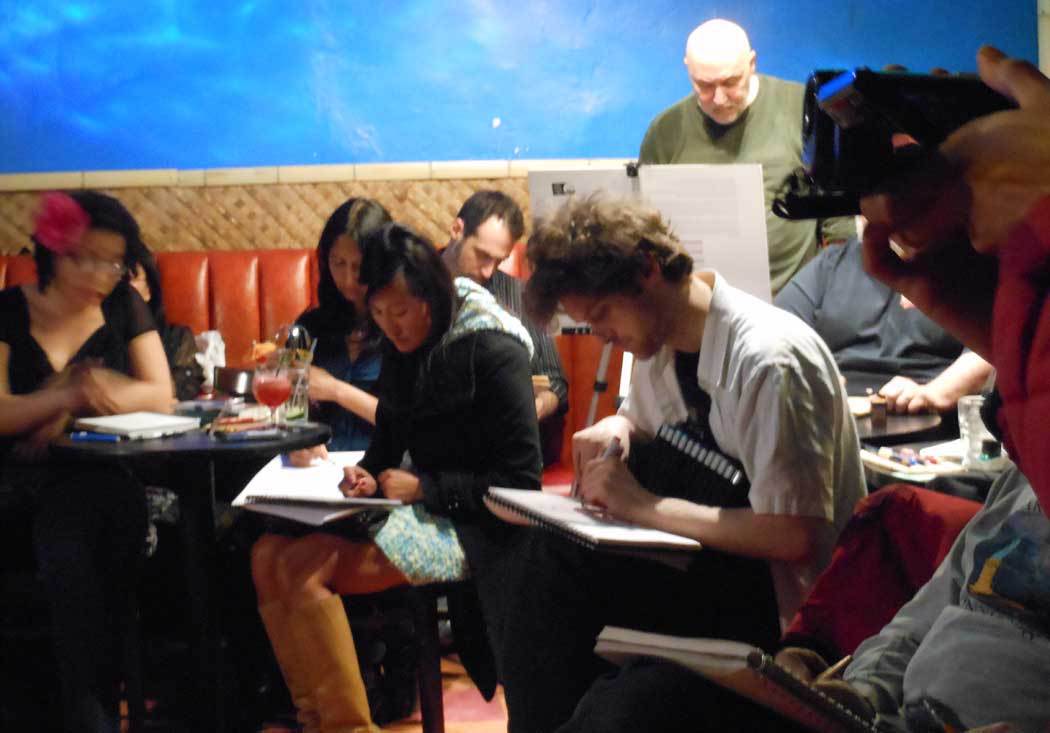
Draw-mania!, our monthly draw-a-thon and variety show, has really taken off! We're approaching our 15th event, and we're going strong into the coming year. If you've never been to one, just imagine a space filled with over 30 artists of all skill levels, from absolute beginners to seasoned pros, sketching, chatting, and, should they so desire, drinking, as they draw from 6 of the top art models for four hours! There's a break for the models every 20 minutes, and that's when a comedian, storyteller or musician takes the stage for a 10 minute performance. It' a blast!
We've been going strong every last Monday of the month in the East Village, at the possibly legendary and always amazing Otto's Shrunken Head (538 East 14th st.). Well, Starting in March, we're adding a second monthly Draw-mania!, just across the Hudson river, in Hoboken, NJ! If you're not familiar with Hoboken, you should be! It's incredibly close to Manhattan (The Hoboken PATH Train station is about 8 minutes from Manhattan's 14th st. & 6th Ave PATH station), and in the 80s it was where all the artists went after Soho priced them out. Nowadays, it's a cool, cozy neighborhood that features a lot of unpretentious bars and restaurants. We'll be at Teak on the Hudson (16-18 Hudon Place), a rather upscale place with a fun, exotic vibe, great cocktails and food, and an amazing riverfront view! Our first event will be March 6th, 8pm to midnight, and I'm putting together a great lineup of models and performers.
Hope you can make it, it's gonna be a blast!
for more info:
www.draw-mania.com
If you're on Facebook:
https://www.facebook.com/DrawMania
And if you're on Meetup.com:
http://www.meetup.com/FigureSketching-NYC/
http://www.meetup.com/Figure-Drawing-HOBOKEN-Draw-Mania/
Friday, February 15, 2013

Wednesday, May 30, 2012
Looking for modeling work? Here's some guidelines...

I run a few classes, but not that many, and I have a limited number of availabilities for models, nevertheless, being out there, models frequently contact me looking for work. But one thing that really strikes me is how badly a lot of models present themselves. I'm currently in the "self-improvement" field and I coach people is all sorts of business and goal related skills, and before that I worked in advertising for many years, where I often freelanced and had to promote myself, and just as frequently was in charge of projects where I did the hiring. So I've been on both sides of that coin.
Here are a few pointers in presenting yourself--your best self.
First Impressions are HUGE
Remember that the first impression you make will color everything else people will find out about you, so make a solid, professional first impression.
Present Yourself Professionally
The first contact you have with a prospective employer should give them the impression that you know your business and that you have a clear grasp of what the job entails.
Be Honest
You don't have to lie about your experience if you don't have a lot. But don't sell yourself short, either.
Pricing
Do some research and find out what is reasonable to charge your clients. The fees a model gets vary widely in different parts of the country. You don't want to cheat yourself out of some bucks, but you also don't want to price yourself out of work, either. Call the kind of places you want to work and ask questions, talk to other models, and find out what's reasonable. Remember, also, that rates for drawing classes differ widely from photography. Some people will want to haggle with you for a lower rate, others can't afford to pay more than a certain rate, so know what you're willing to work for, and whether you're flexible on that point. In any case, don't start looking for gigs without an idea of what you'll be getting, and don't be shy about asking.
PUTTING IT ALL TOGETHER
DON'T
Send an email asking "Hey--need a model?" and wait for a response before sending more. You won't get a response. I get a lot of emails like this, and I no longer even respond. It tells me whoever sent it isn't really putting much effort into their modeling, and no particular pride in it. They may not have ever modeled before. There are plenty of models who take their job seriously and want the people they contact to know it.
And don't forget to check your spelling. I'm a terrible speller, but I've discovered no matter how smart I am (or think I am), if I spell words wrong, I don't get taken seriously. So I found a free plug-in for my browser that checks my spelling.
Don't agree to take a job until you find out what they're paying!! I try to be very fair and upfront, but I'm surprised how many models will agree to take a job before I've even told them the particulars.
Don't stalk a potential employer! If they have a class that's open to the public, it's probably OK to drop in and say hello, and maybe (ideally) drop off a printed copy of your description and picture (see below). You should definitely follow up with everyone you've contacted for work maybe every 2-3 weeks, but for heaven's sake don't call or email every week, call several times a day, or any of those things you wouldn't want your ex to do.
DO
Send a brief business-like letter, just one or two paragraphs, that describes yourself, the kind of modeling work you're looking for, your experience (If you've modeled for well known schools, artists or been in well known projects, let people know! Don't be shy, show off!), areas where you're willing to work (how far you're willing to travel, for example) and anything else you think might be pertinent. Be sure to include contact information.
And definitely include a picture or a link to a web portfolio, if you have one. Your work involves inspiring artists with your appearance, so share it! Don't necessarily send nudie pic, in fact, even if you're looking for nude work, I think it's better not to until you know more about who you're contacting. Do send a nice headshot. It doesn't have to be professionally taken, just nice and clear. It will help people remember you, give them an idea of your look and body type, and give you a huge advantage. If you've been modeling a while, you might want to put up a web gallery of your favorite pix. It can be very persuasive.
If you're comfortable with the price you want to charge, you can consider putting it into your email, though some people think it's better to discuss your rate only when you talk to the person on the phone or in email exchange. Personally, I always like to save the talk of pay until I talk on the phone with a person when doing any kind of job discussion. You can get a better feel for the kind of a person you're dealing with and what kind of a job it is.
I hope this info is both helpful and lucrative. There are a few older posts on this topic and other model-related information. feel free to read it, share it and comment on it. I'd love to hear what you have to say.
Wednesday, April 11, 2012
Draw-mania! Testimonials
Sure, I have great things to say about Draw-mania!, our monthly art-a-thon extravaganza, but what do the people who come to Draw-mania! think about it? Watch!
http://www.draw-mania.com
http://www.draw-mania.com
Thursday, March 8, 2012
Come To Our Events! NOW!
I guess I've been remiss in posting to the blog for a while. But as many of you know, We've been going strong out in the real world! Summer Sketch session are still meeting roughly every two weeks. You can sign up for the next one(s) here: http://www.meetup.com/FigureSketching-NYC/
 And in concert with my friend Pedro Hernandez, and an incredible crew of models, we've been presenting the Draw-mania! draw-a-thon, which is now a monthly event at Otto's Shrunken Head on 14th street in Manhattan, the last Monday evening of each month. We feature half a dozen of your favorite art models (some of the top models in the city!), a terrific DJ, and a ever-changing assortment of performers to entertain during the breaks. For the latest on that, go to th website http://www.draw-mania.com and like the Draw-mania! page on Facebook http://www.facebook.com/drawmania


Saturday, November 5, 2011
The Devil really is in the details!

ROME (Reuters) - Art restorers have discovered the figure of a devil hidden in the clouds of one of the most famous frescos by Giotto in the Basilica of St Francis in Assisi, church officials said on Saturday.
The devil was hidden in the details of clouds at the top of fresco number 20 in the cycle of the scenes in the life and death of St Francis painted by Giotto in the 13th century.
The discovery was made by Italian art historian Chiara Frugone. It shows a profile of a figure with a hooked nose, a sly smile, and dark horns hidden among the clouds in the panel of the scene depicting the death of St Francis.
To read the rest of this article, click on the Yahoo link:
Monday, October 31, 2011
Drawing in 3D VIDEO!
The Drawing in 3D article has been converted into a brief video. This covers the very basic basics of shading to create a sense of depth. Have a look! Share it with anyone you know who may like it, and please do leave feedback!
Monday, October 24, 2011
What materials should I bring for my first figure drawing class?
This is a question that comes up often, and different schools and different teachers might have specific requirements for their students. Since the Summer Sketch Group is a casual, uninstructed drawing session, there are no requirements, but I'll offer you some good basics to start with, and explain why I recommend them. You'll find that these are also the same items that are most commonly suggested to beginners in many schools.
Paper (to draw on, of course)
 There are many different kinds of paper, but hands down, the most popular kind for beginners is rough newsprint. Newsprint is basically the stuff they print newspapers on. It's cheaply made of recycled paper and wood pulp and it's very inexpensive, so you can go through a lot of it without spending a lot of money. Rough Newsprint also has a rough texture, and a kind of softness, which makes it excellent for use with softer drawing materials like charcoal, drawing chalk, dry pastels and crayons. In fact, many of the top anatomy and drawing teachers absolutely love drawing on newsprint for its particular feel when drawing. You might too.
The biggest drawback of newsprint is that it's not made to last. It has an acidic nature and eventually turns brown and crumbly, just like an old newspaper. It also tends to be unsized, which means that it's absorbent, and so not great for paint or markers. Still, it's great to start with and fun to draw on.
The next most common type of paper is called Sketch Paper. The companies that make sketch paper typically also make Drawing paper, and the sketch paper is usually just a thinner version of the drawing paper, and typically somewhat less expensive than the drawing paper. These papers are bright white, "acid free" so they won't turn yellow and crumbly, and are "sized" which means they've been treated with a starch solution to make them less absorbent so they're good to use with paints, ink and markers. Sketch paper is more expensive than newsprint.
What Size paper to bring?
Good question! Most of us feel comfortable with notebooks that are 8 1/2" x 11" in size, but art schools usually ask students to buy pads that are much bigger. Why is that?
The bigger the paper, the more detail you can put in your drawings! And the more details you put in your drawings, the more you train your eyes to see detail the details.
At the same time, it doesn't do you any good if you're still doing little drawings swimming on a giant page. I generally recommend getting the biggest pad you can comfortably carry under your arm, usually about 11 x 14" or 12 x 18." These pads also work well if propped up against a chair, while the bigger pads sometimes need an easel, or an additional back board to support them and keep them from flopping around. But remember, there is no "right" or "wrong" in art. If you want to use bigger pads, do it! They're sitting on the art store shelves for you.
Drawing Materials
 Charcoal is probably the most classic of all drawing materials, and certainly one of the first. Cavemen used it! Charcoal is simply burnt wood. It comes in a variety of different types and is also inexpensive. Here are the most common types:
Vine Charcoal
These thin strips of charcoal are actually what is left behind when vines are baked in a kiln. The remnants are light and brittle, and they leave a light, delicate line on the paper which can be brushed off of some papers easily. It's popularly used for the underdrawings of paintings. Some people really like the texture of it.
Willow Charcoal
Is very similar to vine charcoal. sticks of willow wood are baked in kiln until only charcoal is left. It has the delicate properties of vine charcoal, but the pieces are bigger and stringer and sometimes produce a darker line.
Compressed Charcoal
Think of this as charcoal compressed into sticks that are square or round in cross-section. In actual fact, the charcoal is usually ground to a fine powder and mixed with a binding agent, and sometimes clay or other ingredients to give it a smoother texture to draw with and better adherence to the paper. Compressed charcoal is heavier than the others, and also offers a broader tonal range that the unprocessed charcoals, which is to say you can get much darker shadows and lines that with the others. Compressed charcoal usually comes is different degrees of hardness. The softer it is,the easier it is to smudge and blend, and also the softer ones will let you make darker marks on the paper.
All of the above charcoals can be used to draw thin lines with the point, like a pencil, or you can use the side of the charcoal to get a broad sweep of color onto your paper.
Charcoal Pencils
Compressed charcoal in a pencil! You can't put down broad sweeps of color the way you can with a charcoal stick, but you can get more accurate lines and sharpen it like a pencil, and it's less messy.
For bigger pads, above 11 x 14" I do NOT recommend pencils, simply because it takes too long to fill in large areas, and you can get hung up in little details and lose sight of the whole drawing.
Other fun materials:
There are many other materials that you can use in a figure drawing class. many of them come in a stick or block shape similar to compressed charcoal.
Graphite Sticks
Graphite, the same stuff in your pencil, can be got in big crayon-like sticks. Actually the "lead" in you pencil is a combination of graphite powder, wax and sometimes other ingredients (but no lead!). Graphite sticks are sometimes rated in hardness scares just like pencils or compressed charcoal.
Dry Pastels (Drawing chalk)
 Dry pastels are made of finely powdered artist's pigments mixed with a binder exactly like the kind used in the making of compressed charcoal. They are fun to use and come in a huge variety of colors. Traditionally, carbon black, sepia, sienna and umbar (all shades of brown, except for the black, of course) are sued for figure drawing, but you can choose any color you like! Some popular brands include Conte Crayons, Neupastels, Koh-I-Noor, and Alphacolor.
Oil Pastels
These are a kind of crayon made of finely powdered pigment combined with an oil. Pastels for kids, like Cray-pas brand, are combined with mineral oil. They never dry up and are fairly easy to wash off hands with soap and water. Artists' pastels are combined with an oil medium which will eventually dry, making your drawings permanent. Oil pastels have a rich texture when going on the paper, are easy to blend and come in many colors.
Oil Bars
Are very similar to oil pastels--big bars of color, comprised of pigment, wax and an oil that eventually dries. These are bigger than pastels and offer the opportunity for bigger art works and more painterly effects. Two popular brands are from Shiva and Windsor Newton.
Crayons
Yeah, I'm thinking of Crayolas! Cheap and easy to come by, good quality crayons offer a great range of colors and very little mess. Actually, many different art supply manufacturers make wax crayons, and some offer excellent quality. Some are even water-soluble, and can be gone over with a wet paintbrush for more effects. Some good brands are Crayola, Prang, and Caran D'ache.
Markers
Broad markers can be fun to draw with. You can fill big areas of color fast, the marker are inexpensive and the felt tips can be very expressive. The drawbacks of markers are that some use smelly solvents (alcohol or other solvents), and the ink gets absorbed into the paper more easily than most other drawing mediums, so the lines might "bleed" and get fuzzy on some papers.
Brush and Ink or Paint
 A watercolor brush with flexible bristles is great for sketching with! Watercolor brushes typically come to a fine point, and also spread, so with a little careful handling, you can get a great variety of line-width. You can also use water "washes" to get a big tonal range. Some people use a bottle of ink, and put a few drops of it in a little dish, or right from the bottle (illustrators like to use permanent link, or "India Ink" which becomes waterproof when it dries, but fountain pen ink, which is water-soluble, also works well). Both kinds of ink come in many colors.
 You can also use watercolor paints in a similar way you'd use ink. Watercolors come in a solid cake which you can just stroke a wet brush over, and also as a paste in tubes. Watercolor is always water-soluble.
 In addition to watercolor brushes, Asian (Chinese & Japanese) calligraphy brushes are a good choice. The usually have excellent points and nice responsiveness, and there are many inexpensive ones that work well. These brushes have either brown bristles, which are very much like sable brushes and create a sharp, clean line, or white bristles, which are more flexible and create a softer mark.
Asian calligraphy inks are also a great choice. They come in bottles and sticks. The sticks have to be ground on a special stone palette, but the bottled ink can be used just like any other bottled ink. Asian inks are made from pine soot and produce a very dark black which can be diluted for a very broad range of tones.
Hope that gives you enough to get started with! Find the ones that appeals to you, and get comfortable using them. After that, if you like, try some of the others. Art is all about experimenting and developing your skill. Practice and have fun.
All images are public domain, courtesy Wikimedia Commons http://commons.wikimedia.org/
Paper (to draw on, of course)
 There are many different kinds of paper, but hands down, the most popular kind for beginners is rough newsprint. Newsprint is basically the stuff they print newspapers on. It's cheaply made of recycled paper and wood pulp and it's very inexpensive, so you can go through a lot of it without spending a lot of money. Rough Newsprint also has a rough texture, and a kind of softness, which makes it excellent for use with softer drawing materials like charcoal, drawing chalk, dry pastels and crayons. In fact, many of the top anatomy and drawing teachers absolutely love drawing on newsprint for its particular feel when drawing. You might too.
The biggest drawback of newsprint is that it's not made to last. It has an acidic nature and eventually turns brown and crumbly, just like an old newspaper. It also tends to be unsized, which means that it's absorbent, and so not great for paint or markers. Still, it's great to start with and fun to draw on.
The next most common type of paper is called Sketch Paper. The companies that make sketch paper typically also make Drawing paper, and the sketch paper is usually just a thinner version of the drawing paper, and typically somewhat less expensive than the drawing paper. These papers are bright white, "acid free" so they won't turn yellow and crumbly, and are "sized" which means they've been treated with a starch solution to make them less absorbent so they're good to use with paints, ink and markers. Sketch paper is more expensive than newsprint.
What Size paper to bring?
Good question! Most of us feel comfortable with notebooks that are 8 1/2" x 11" in size, but art schools usually ask students to buy pads that are much bigger. Why is that?
The bigger the paper, the more detail you can put in your drawings! And the more details you put in your drawings, the more you train your eyes to see detail the details.
At the same time, it doesn't do you any good if you're still doing little drawings swimming on a giant page. I generally recommend getting the biggest pad you can comfortably carry under your arm, usually about 11 x 14" or 12 x 18." These pads also work well if propped up against a chair, while the bigger pads sometimes need an easel, or an additional back board to support them and keep them from flopping around. But remember, there is no "right" or "wrong" in art. If you want to use bigger pads, do it! They're sitting on the art store shelves for you.
Drawing Materials
 Charcoal is probably the most classic of all drawing materials, and certainly one of the first. Cavemen used it! Charcoal is simply burnt wood. It comes in a variety of different types and is also inexpensive. Here are the most common types:
Vine Charcoal
These thin strips of charcoal are actually what is left behind when vines are baked in a kiln. The remnants are light and brittle, and they leave a light, delicate line on the paper which can be brushed off of some papers easily. It's popularly used for the underdrawings of paintings. Some people really like the texture of it.
Willow Charcoal
Is very similar to vine charcoal. sticks of willow wood are baked in kiln until only charcoal is left. It has the delicate properties of vine charcoal, but the pieces are bigger and stringer and sometimes produce a darker line.
Compressed Charcoal
Think of this as charcoal compressed into sticks that are square or round in cross-section. In actual fact, the charcoal is usually ground to a fine powder and mixed with a binding agent, and sometimes clay or other ingredients to give it a smoother texture to draw with and better adherence to the paper. Compressed charcoal is heavier than the others, and also offers a broader tonal range that the unprocessed charcoals, which is to say you can get much darker shadows and lines that with the others. Compressed charcoal usually comes is different degrees of hardness. The softer it is,the easier it is to smudge and blend, and also the softer ones will let you make darker marks on the paper.
All of the above charcoals can be used to draw thin lines with the point, like a pencil, or you can use the side of the charcoal to get a broad sweep of color onto your paper.
Charcoal Pencils
Compressed charcoal in a pencil! You can't put down broad sweeps of color the way you can with a charcoal stick, but you can get more accurate lines and sharpen it like a pencil, and it's less messy.
For bigger pads, above 11 x 14" I do NOT recommend pencils, simply because it takes too long to fill in large areas, and you can get hung up in little details and lose sight of the whole drawing.
Other fun materials:
There are many other materials that you can use in a figure drawing class. many of them come in a stick or block shape similar to compressed charcoal.
Graphite Sticks
Graphite, the same stuff in your pencil, can be got in big crayon-like sticks. Actually the "lead" in you pencil is a combination of graphite powder, wax and sometimes other ingredients (but no lead!). Graphite sticks are sometimes rated in hardness scares just like pencils or compressed charcoal.
Dry Pastels (Drawing chalk)
 Dry pastels are made of finely powdered artist's pigments mixed with a binder exactly like the kind used in the making of compressed charcoal. They are fun to use and come in a huge variety of colors. Traditionally, carbon black, sepia, sienna and umbar (all shades of brown, except for the black, of course) are sued for figure drawing, but you can choose any color you like! Some popular brands include Conte Crayons, Neupastels, Koh-I-Noor, and Alphacolor.
Oil Pastels
These are a kind of crayon made of finely powdered pigment combined with an oil. Pastels for kids, like Cray-pas brand, are combined with mineral oil. They never dry up and are fairly easy to wash off hands with soap and water. Artists' pastels are combined with an oil medium which will eventually dry, making your drawings permanent. Oil pastels have a rich texture when going on the paper, are easy to blend and come in many colors.
Oil Bars
Are very similar to oil pastels--big bars of color, comprised of pigment, wax and an oil that eventually dries. These are bigger than pastels and offer the opportunity for bigger art works and more painterly effects. Two popular brands are from Shiva and Windsor Newton.
Crayons
Yeah, I'm thinking of Crayolas! Cheap and easy to come by, good quality crayons offer a great range of colors and very little mess. Actually, many different art supply manufacturers make wax crayons, and some offer excellent quality. Some are even water-soluble, and can be gone over with a wet paintbrush for more effects. Some good brands are Crayola, Prang, and Caran D'ache.
Markers
Broad markers can be fun to draw with. You can fill big areas of color fast, the marker are inexpensive and the felt tips can be very expressive. The drawbacks of markers are that some use smelly solvents (alcohol or other solvents), and the ink gets absorbed into the paper more easily than most other drawing mediums, so the lines might "bleed" and get fuzzy on some papers.
Brush and Ink or Paint
 A watercolor brush with flexible bristles is great for sketching with! Watercolor brushes typically come to a fine point, and also spread, so with a little careful handling, you can get a great variety of line-width. You can also use water "washes" to get a big tonal range. Some people use a bottle of ink, and put a few drops of it in a little dish, or right from the bottle (illustrators like to use permanent link, or "India Ink" which becomes waterproof when it dries, but fountain pen ink, which is water-soluble, also works well). Both kinds of ink come in many colors.
 You can also use watercolor paints in a similar way you'd use ink. Watercolors come in a solid cake which you can just stroke a wet brush over, and also as a paste in tubes. Watercolor is always water-soluble.
 In addition to watercolor brushes, Asian (Chinese & Japanese) calligraphy brushes are a good choice. The usually have excellent points and nice responsiveness, and there are many inexpensive ones that work well. These brushes have either brown bristles, which are very much like sable brushes and create a sharp, clean line, or white bristles, which are more flexible and create a softer mark.
Asian calligraphy inks are also a great choice. They come in bottles and sticks. The sticks have to be ground on a special stone palette, but the bottled ink can be used just like any other bottled ink. Asian inks are made from pine soot and produce a very dark black which can be diluted for a very broad range of tones.
Hope that gives you enough to get started with! Find the ones that appeals to you, and get comfortable using them. After that, if you like, try some of the others. Art is all about experimenting and developing your skill. Practice and have fun.
All images are public domain, courtesy Wikimedia Commons http://commons.wikimedia.org/
Subscribe to:
Posts (Atom)